
How Air Quality Impacts Sports Performance in Australia’s Indoor Facilities
In a nation where sport is woven into the cultural fabric, Australia’s athletes – from weekend warriors to professionals – are facing a growing, often invisible challenge: air quality. While the conversation often focuses on outdoor hazards like bushfire smoke and pollution, indoor sports facilities are far from immune. Increasingly, coaches, athletes, and venue operators are asking: what are we really breathing indoors, and how does it affect performance?
The Air We Breathe – And Its Consequences
Australia’s recent bushfire seasons and urban pollution spikes have pushed air quality into the national spotlight. The Australian Institute of Sport (AIS) has updated guidelines warning of the effects of PM2.5 (fine particulate matter) on elite athletes. Exposure to high levels of these pollutants has been linked to respiratory inflammation, reduced VO₂ max, and compromised endurance – factors that directly impact athletic output.
When air quality indexes (AQI) exceed 150, events may be rescheduled. Even moderate levels (>50) can harm vulnerable athletes, triggering decisions to move training indoors. But indoors doesn’t automatically mean “safe.”
Indoor Isn’t Always Better
A study published in Building and Environment (Zhang et al., 2021) showed that indoor CO₂ concentrations commonly exceed 1,200 ppm in high-occupancy exercise facilities — levels linked to impaired concentration, slower reaction times, and increased perceived exertion. These impacts can be subtle yet significant in competitive or high-performance sports environments.
Similarly, The Guardian reported on findings from the Harvard T.H. Chan School of Public Health, which revealed that even modest increases in indoor air pollutants can decrease cognitive function scores, particularly in areas involving decision-making, strategy, and response time — all crucial elements in fast-paced sports settings.
Engineering a Healthier Performance Environment
As the need for resilient, high-performance indoor spaces grows, so does the role of building automation and air quality technology. At IES Automation, we’ve seen firsthand how proactive environmental control can elevate both well-being and performance.
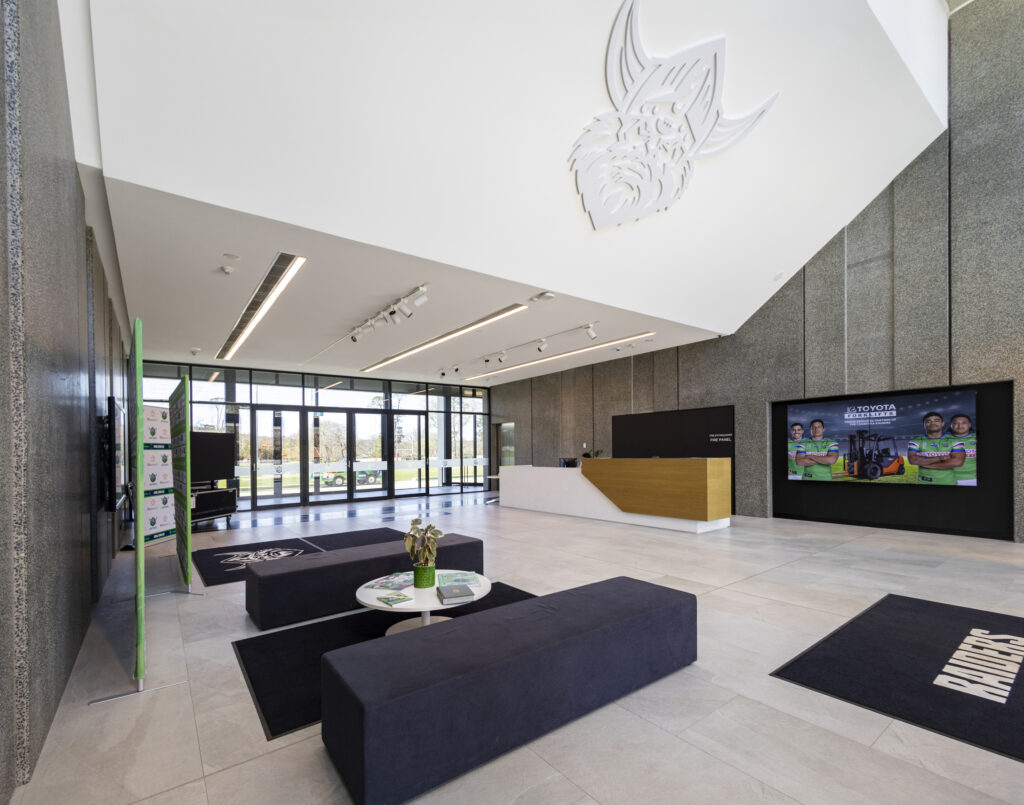
Case Study: Raiders Centre of Excellence
Take the Raiders Centre of Excellence in Braddon, ACT, a state of the art indoor training facility for the Canberra Raiders NRL team. During the project, IES Automation delivered a fully integrated Building Management System (BMS) tailored to athlete performance and health. Key features include:
- CO₂ monitoring and automated ventilation, ensuring consistent indoor air renewal even during high-occupancy training sessions.
- Humidity and temperature regulation, optimised for recovery and endurance training.
- Energy-efficient air purification systems, reducing airborne particulates without compromising sustainability goals.
This system doesn’t just comply with health standards – it enables peak performance by maintaining a stable, breathable, and comfortable environment for players and staff.
The assumption that indoor equals safe is being re-evaluated across the industry. Smart buildings now empower sports facilities to actively monitor, respond to, and enhance the environments athletes train in. Rather than being reactive to air quality issues, advanced BMS platforms allow for real-time adjustments that support both health and high performance.
The Invisible Performance Drain
When athletes train or compete in stale air, their bodies are forced to work harder — not because of the workout, but because of the environment. Elevated CO₂ leads to reduced oxygen delivery to muscles and the brain, while high humidity can make thermoregulation more difficult, leading to faster fatigue. Dust, dander, and PM2.5 particles can trigger respiratory irritation, reducing lung efficiency and VO₂ max, even in healthy individuals.
For youth and community athletes, the risks are even higher. Children breathe more air per kilogram of body weight than adults, and their respiratory systems are still developing. Ensuring healthy air in indoor sports facilities isn’t just a performance issue — it’s a public health responsibility.
How can we make smarter and Safer Sports Environments
The solution lies in real-time visibility and control. Smart building systems, like those installed at the Raiders Centre of Excellence, transform indoor spaces from static environments into responsive, performance-enhancing ecosystems.
With continuous monitoring of CO₂, temperature, humidity, PM2.5, and VOCs, these systems give facility managers the power to:
- Adjust ventilation in response to occupancy spikes
- Maintain optimal temperature and humidity for performance and recovery
- Identify and address air quality risks before they affect users
This data-driven approach ensures that athletes and coaches can focus on training, knowing that the space around them is actively supporting — not undermining — their goals.
A New Standard for Sports Facilities
As awareness grows, athletes and facility managers alike are demanding more from their indoor environments. Air quality is no longer just a comfort factor, it’s part of the performance equation.
For clubs, schools, and commercial gyms, investing in intelligent air quality systems is no longer a nice-to-have. It’s a competitive advantage. It’s future-proofing. And, most importantly, it’s the right thing to do.